JINPAT Integrated Through-Bore Slip Rings: The Solution for Rotary Table Selection Challenges
Limited space, an excessive number of circuits, concerns regarding Gigabit Ethernet transmission through the slip ring, and signal interference—JINPAT provides practical and effective solutions to address these four common challenges encountered in rotary table design.
2026-04-22 18:03 by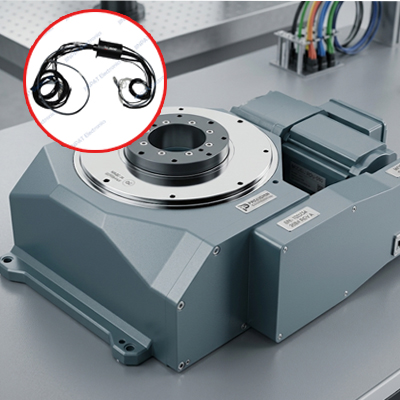
- Share
-

-

-

-

-

Have you ever been troubled by the following issues when selecting a slip ring for a rotary table? Here, utilizing JINPAT integrated through-bore slip ring solutions, we provide you with direct and definitive answers.
Q1: The central through-bore diameter is merely a dozen millimeters, yet it needs to transmit over a dozen signal circuits as well as Gigabit Ethernet signals. What should be done if standard slip rings do not offer a sufficient number of circuits?
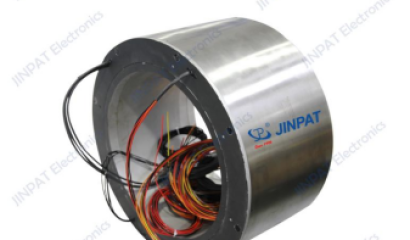
A: JINPAT integrated through-bore slip rings employ a unique "ring-within-a-ring" structure—integrating a smaller electrical slip ring inside the main slip ring body. Space that would originally accommodate only 8 circuits can now accommodate 15 or even more. Achieving higher circuit density integration within limited space is precisely the core advantage of this design.
Q2: When Gigabit Ethernet signals are transmitted through a slip ring, issues such as data packet loss often occur. What level of Bit Error Rate (BER) can actually be guaranteed?
A: JINPAT has designed dedicated channels specifically for Gigabit Ethernet transmission that feature shielding capabilities and impedance matching. Actual test results demonstrate that the Bit Error Rate (BER) of the signal after passing through the slip ring is ≤10⁻⁹. This figure implies that for every one billion bits of data transmitted, at most only one error will occur—which is equivalent to streaming video continuously for a month and potentially losing only a single pixel.
Q3: If power lines and encoder signal lines share the same slip ring, will they interfere with one another?
A: A key advantage of the integrated design is the ability to segregate different categories of circuits into distinct layers and zones within the layout. JINPAT implements physical isolation between the internal miniature slip ring and the larger external slip ring, while simultaneously applying dedicated shielding measures for sensitive signals, such as encoder feedback and analog data. Consequently, even while the rotary table is in continuous rotation, the position feedback signals remain stable, thereby completely eliminating the occurrence of "code skipping."
Q4: Is this integrated slip ring easy to install?
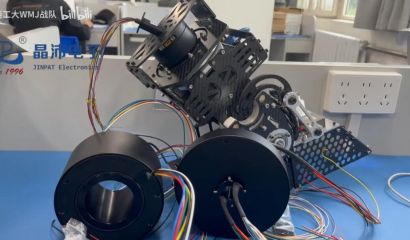
A: Thanks to its inherent hollow-shaft design, the unit can be mounted directly onto the rotary table's main shaft without the need for additional couplings. Its axial length is significantly shorter than that of configurations utilizing two separate slip rings, making it an ideal solution for rotary table equipment with strict height constraints.
In summary: If you require a single rotating assembly that simultaneously delivers a compact footprint, multi-channel circuit transmission, low-bit-error-rate Gigabit Ethernet connectivity, and integrated power and data transmission, then JINPAT integrated through-bore slip ring is undoubtedly one of the few products currently on the market that truly offers "all-around" performance.